
H1 in Leaving Cert Business: Your Essential Guide to Subject Choice
If you’re in TY or fifth year and wondering whether to take Business for the Leaving Cert, you’re not alone. Every year, thousands of students across Ireland face the same decision. It’s a choice that can shape your understanding of the corporate world, entrepreneurship, and how the economy affects everyday life.
In this essential guide, we’ll break down exactly what the Leaving Cert Business course involves, correct some common myths about the exam structure, and show you why aiming for an H1 in Leaving Cert Business might be one of the smartest moves you can make for your future.
🧭 What Is Leaving Cert Business All About?
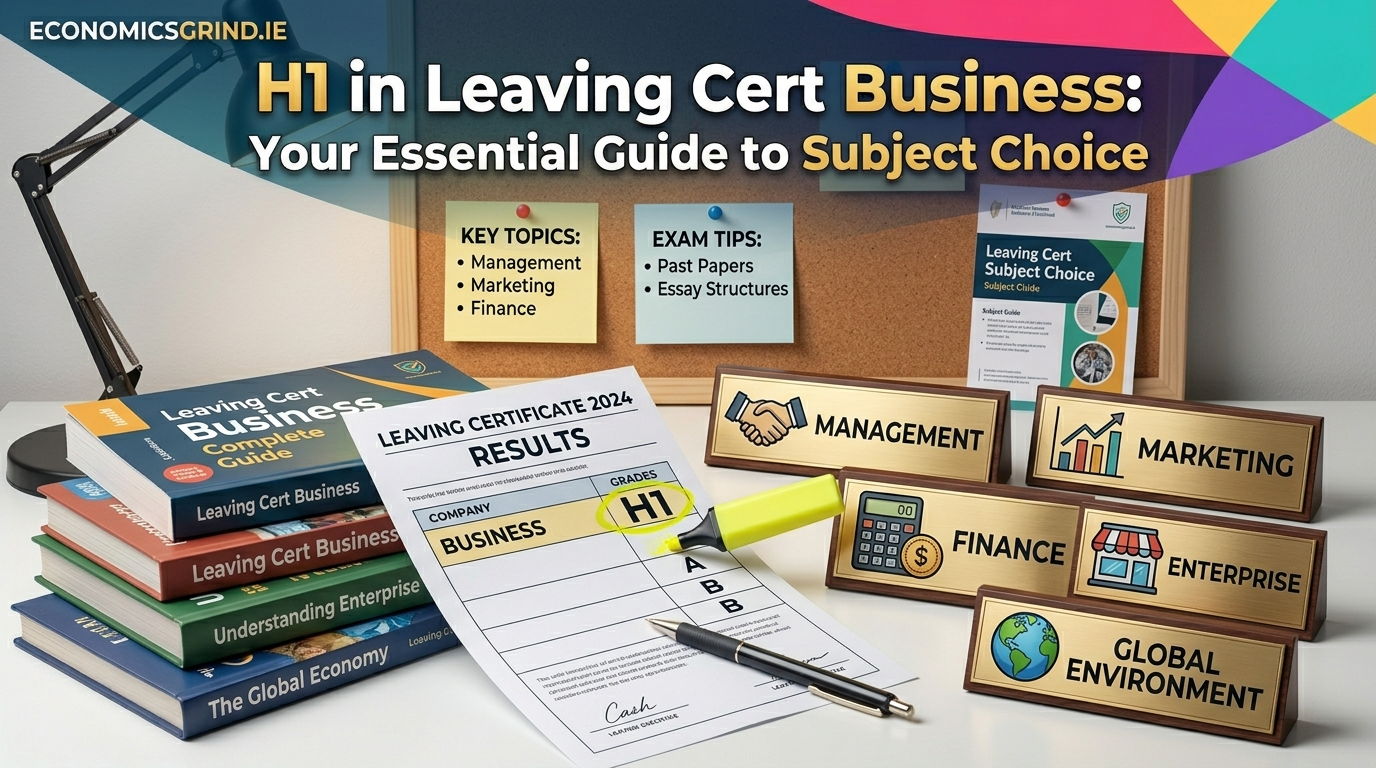
Leaving Cert Business focuses on how organizations work, from small local sole traders to massive multinational corporations. Rather than dealing with abstract theories, you’ll learn about real-world concepts you interact with daily:
-
People in Business: Relationships, conflicts, and legislation (like consumer protection and employment law).
-
Enterprise and Management: How entrepreneurs spot gaps in the market and how managers lead, motivate, and organize teams.
-
Marketing: How products are priced, promoted, and placed in front of customers.
-
The Global Environment: How international trade, the European Union, and global forums impact Irish businesses.
The Good News: It is not a heavily mathematical subject. While you will learn to calculate a few basic ratios and break-even charts, it is primarily a conceptual, analytical subject. If you are a logical thinker and a good problem solver, you will thrive here.
💡 Why Choose Business for the Leaving Cert?
1. 100% Written Exam (No Project Pressure)
Unlike subjects like Economics, Geography, or History, Business has no continuous assessment or practical project work. Your entire grade rests on the final 3-hour written paper. For students who prefer a structured, predictable study routine without the stress of mid-year deadlines, this is a massive advantage.
2. Practical Life Skills
This is easily one of the most practical subjects on the senior cycle curriculum. You’ll leave school genuinely understanding how taxes work, your rights as an employee or consumer, and how insurance policies operate.
3. The Perfect Link with Economics
If you are already leaning toward taking Economics, pairing it with Business is a proven strategy. The overlap in topics like market structures, government intervention, and international trade means you effectively reduce your overall study load.
4. An Ideal Foundation for University
Whether you want to pursue Business, Marketing, Finance, Law, or international relations at third level, this syllabus gives you a major head start on university-level material.
📘 The Exam Structure: Fact vs. Fiction
To secure that top grade, you need to understand exactly how the Higher-Level paper is laid out. The exam is 3 hours long and worth a total of 400 marks.
It is strictly divided into three distinct sections:
| Section | Format | Marks Breakdown |
| Section 1: Short Questions | Answer 8 out of 10 short-answer questions covering the whole syllabus. | 80 Marks (20% of total) |
| Section 2: Applied Business Question (ABQ) | A compulsory, unseen case study based on specific designated units of the course. | 80 Marks (20% of total) |
| Section 3: Long Questions | Essay-style structured answers. You choose 3 out of the available options. | 240 Marks (60% of total) |
⚠️ The Truth About the ABQ
A common myth is that the ABQ case study is released before the exam. It is not. While the State Examinations Commission (SEC) tells us exactly which Units the case study will test each year, you will read the actual text of the story for the first time in the exam hall. Success here relies entirely on knowing your core theory and mastering the specific “State, Explain, Link” exam technique.
🚀 How to Secure an H1 in Leaving Cert Business
Achieving a top grade isn’t just about memorizing a textbook cover to cover; it’s about giving the examiner exactly what they are looking for in the marking scheme.
-
Master the Definitions: Short questions live and die by precise definitions. Create flashcards for every key term in the syllabus. If a question asks for a definition, a vague explanation won’t cut it.
-
Structure with Headings and Bullets: Leaving Cert Business examiners love structure. Never write long, dense paragraphs of text. Use clear headings, bullet points, and underline your keywords to make your answers easy to read and mark.
-
Always Link to the Case Study: In the ABQ, you must explicitly quote or paraphrase from the text. If you don’t anchor your theoretical knowledge directly to the story provided, you lose immediate marks.
-
Use Real-World Examples: When answering long questions, illustrating your points with real Irish and global companies (like Ryanair, Supermac’s, or Stripe) proves to the examiner that you truly understand the material.
✍️ Ready to Get the Edge?
If you want to turn your business interest into a guaranteed high grade, having expert guidance can change everything.
At EconomicsGrind.ie, we don’t just teach the syllabus—we teach the exact exam strategies required to pick up maximum marks. Our tailored grinds simplify complex topics, break down the trickiest past papers, and provide you with high-quality, structured notes designed for the modern Leaving Cert environment.
👉 [Click here to book a free consultation or secure your personalized Leaving Cert Business grind today.]
Don’t leave your points to chance. Start preparing smarter with Ireland’s dedicated platform for Business and Economics success.